
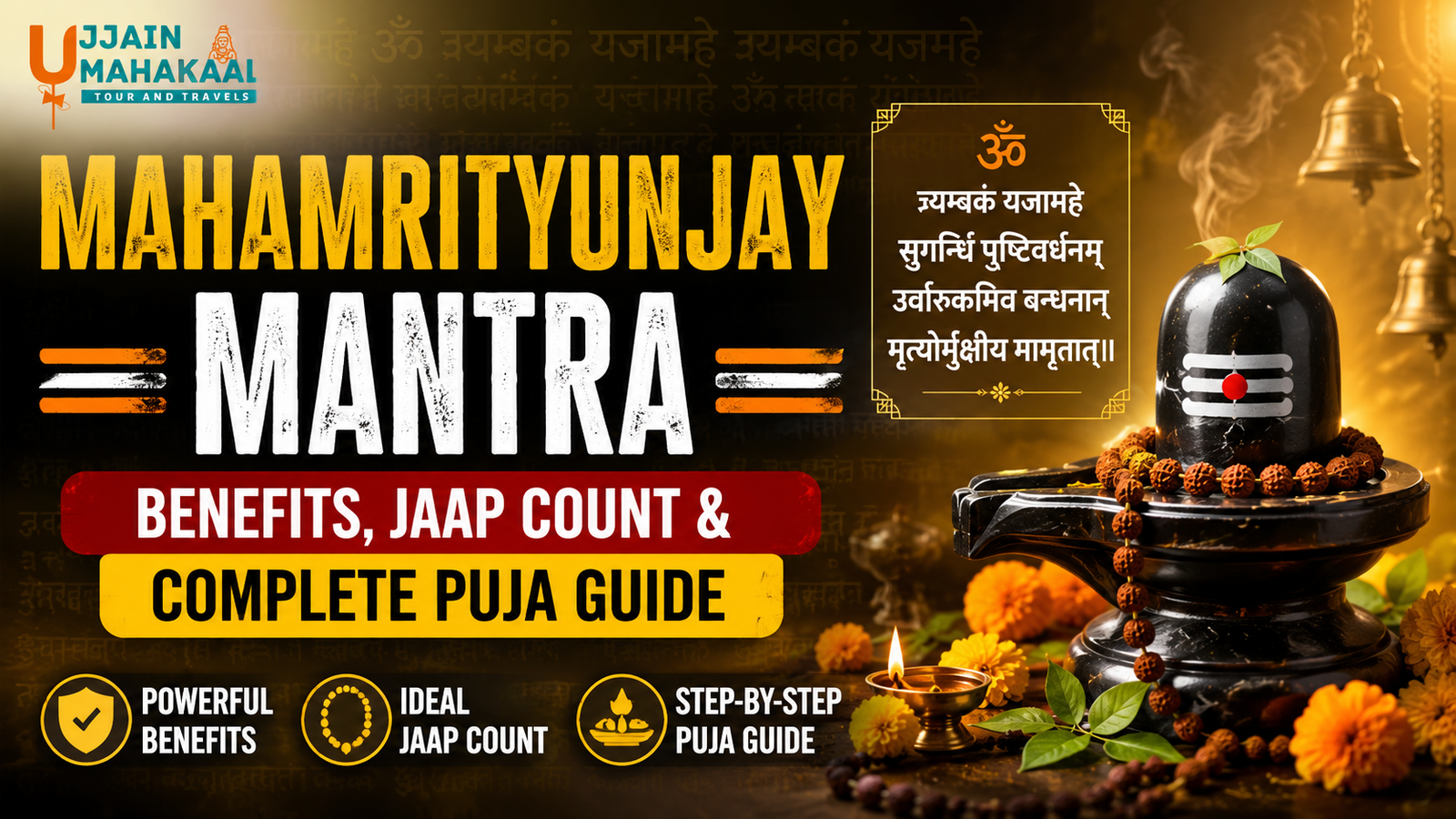
Mahamrityunjay Mantra: Benefits, Jaap Count & Complete Puja Guide
Mahamrityunjay Mantra: Benefits, Jaap Count & Complete Puja Guide There is a mantra in Hindu tradition that has been chanted for thousands of years — by saints in the Himalayas,
There is a mantra in Hindu tradition that has been chanted for thousands of years — by saints in the Himalayas, by families sitting beside a sick loved one, and by millions of ordinary people seeking peace, protection, and the strength to face life’s deepest fears.
That mantra is the Mahamrityunjay Mantra.
If you have ever been inside the Mahakaleshwar Temple in Ujjain during the early morning puja, you have heard its vibration fill the ancient stone walls. The sound is unlike anything else. It reaches something inside you that ordinary words simply cannot.
In this guide, we will cover everything you need to know — what this mantra means, the real benefits of chanting it, how many times you should chant it, and a complete step-by-step puja vidhi you can follow at home, even as a total beginner.
The Mahamrityunjay Mantra is one of the oldest and most sacred mantras from the Rigveda. It is addressed to Lord Shiva in his form as Tryambaka — the three-eyed one — who holds the power to grant liberation from the cycle of birth, death, and suffering.
ॐ त्र्यम्बकं यजामहे सुगन्धिं पुष्टिवर्धनम् । उर्वारुकमिव बन्धनान्मृत्योर्मुक्षीय माऽमृतात् ॥
Roman Transliteration: Om Tryambakam Yajamahe Sugandhim Pushtivardhanam Urvaarukamiva Bandhanaan Mrityor Mukshiya Maamritaat
| Sanskrit Word | Meaning |
| Om | The primordial sound, the universal consciousness |
| Tryambakam | The three-eyed Lord (Shiva) |
| Yajamahe | We worship, we honour |
| Sugandhim | Full of fragrance, spiritually radiant |
| Pushtivardhanam | One who nourishes and strengthens all living beings |
| Urvaarukamiva | Like a ripe cucumber (naturally ready for release) |
| Bandhanaan | From the bondage (of worldly attachments) |
| Mrityor | From death |
| Mukshiya | May we be freed, may we be liberated |
| Maamritaat | Grant us immortality, grant us moksha |
The Mahamrityunjay Mantra’s English translation carries a beautiful message — not a desperate plea to escape death, but a surrender to Shiva, asking to be released with grace when the time comes. Like a ripe fruit separating naturally from the tree.
In Vedic tradition, the word “Mrityu” does not only mean physical death. It also represents ignorance, ego, attachment, and every form of suffering that keeps the soul bound.
When we chant this mantra, we are asking Lord Shiva — the Lord of Mahakal, the master of time itself — to sever those bonds.
This is why the mantra carries several names:
Name | Meaning |
Mahamrityunjay Mantra | The great mantra that conquers death |
Moksha Mantra | The mantra for liberation |
Mrita Sanjivani Mantra | The mantra that revives the spirit |
Rudra Mantra | The fierce mantra of Lord Rudra (Shiva) |
Tryambakam Mantra | Named after Shiva’s three-eyed form |
In Ujjain, where Lord Shiva resides as the Mahakaleshwar Jyotirlinga — the god beyond time and death — the power of this mantra is considered especially deep. Chanting it here, or having a formal puja performed here, is believed to multiply its effect many times over.
| Area | Key Benefit |
| Physical Health | Supports healing, boosts energy, aids recovery from illness |
| Mental Health | Reduces anxiety, brings calm, helps with grief and depression |
| Spiritual Growth | Deepens connection with Lord Shiva, cleanses karma |
| Protection | Guards against accidents, negative energy, and fear |
| Family Well-being | Can be chanted on behalf of a loved one who is unwell |
| Moksha | Long-term practice moves the soul toward liberation |
This is the question most people ask first. The right count depends on your goal and your current practice level.
| Purpose | Recommended Jaap Count | Time Needed |
| Daily spiritual practice | 108 times (1 mala) | 20–25 minutes |
| Healing from illness | 108 times daily for 40 days | ~25 min/day |
| Serious illness or surgery | 1,008 times per session | 3–4 hours |
| Festival or special day | 108 or 1,008 times | Varies |
| Full anushthana (vow) | 1,25,000 times total | Multiple days with pandit |
The Mahamrityunjay Mantra 108 times benefits are cumulative — meaning the effect builds over consistent daily practice. Most experienced practitioners recommend starting with 108 times per day for at least 40 days before attempting longer sessions.
Always use a Rudraksha mala with 108 beads for this mantra. Rudraksha is Lord Shiva’s own bead and is considered the most powerful mala for this particular jaap. Crystal or sandalwood malas can be used as alternatives, but rudraksha is traditional and preferred.
| When | Why It Is Auspicious |
| Brahma Muhurta (4–6 AM) | Most spiritually potent time of day |
| Monday (Somvar) | Day dedicated to Lord Shiva |
| Pradosh Kaal (evening twilight) | Special Shiva worship time |
| Mahashivratri | Most powerful night of the year for Shiva mantras |
| Shravan Month | Every day is auspicious for Shiva during Sawan |
| Ekadashi and Purnima | Naturally high spiritual energy days |
| Rule | Detail |
| Physical cleanliness | Bathe before sitting for jaap |
| Direction | Face east or north while chanting |
| Sitting posture | Sukhasana or Padmasana, spine straight |
| Mala handling | Hold in right hand, use the thumb to count beads |
| Speed | Neither too fast nor too slow — each syllable should be clear |
| Mind | Keep mental focus on Shiva’s form, ideally the Jyotirlinga |
| Diet on puja day | Avoid non-vegetarian food, alcohol, onion, garlic |
| Consistency | If you commit to a 40-day sadhana, do not skip a day |
| Silence after | Sit quietly for 5 minutes after finishing — do not rush away |
You do not need to be at a temple to perform this puja. Here is the full step-by-step home puja procedure.
| Item | Purpose |
| Shivalinga or Lord Shiva photo/idol | Main deity for worship |
| Rudraksha mala (108 beads) | For counting jaap |
| Bel patra (Bilva leaves) | Most sacred offering for Shiva |
| Panchamrit (milk, curd, honey, ghee, sugar) | For abhishek |
| Gangajal or clean water | For purification and abhishek |
| Incense sticks (agarbatti) | To purify the atmosphere |
| Diya (oil or ghee lamp) | Light offering |
| Sandalwood paste (chandan) | For tilak on the deity |
| Fresh flowers | Offering |
| Camphor (kapoor) | For aarti |
| Raw rice grains (akshat) | Traditional offering |
| Fruits or sweets | For prasad at the end |
Step 1 — Purify the space Clean your altar area. Sprinkle Gangajal on the floor around you and on yourself. Light the diya and incense sticks.
Step 2 — Ganesh Vandana Begin with a short prayer to Lord Ganesha to remove all obstacles from your puja.
Step 3 — Abhishek Pour panchamrit slowly over the Shivalinga, followed by Gangajal. As you pour, chant “Om Namah Shivaya” quietly.
Step 4 — Offer Bel Patra and Flowers Bel leaves should be offered in sets of three. These are Lord Shiva’s most beloved offering. Place fresh flowers at his feet.
Step 5 — Chandan and Akshat Apply a small dot of sandalwood paste to the deity and offer raw rice grains with both hands.
Step 6 — Begin Mahamrityunjay Jaap Sit comfortably, pick up your rudraksha mala, close your eyes, and take three slow deep breaths. Begin chanting the Mahamrityunjay Mantra clearly and steadily. Complete 108 rounds (one full mala).
Step 7 — Aarti After completing the jaap, perform aarti with the camphor diya. Sing Om Jai Shiv Omkara or any Shiva aarti you know.
Step 8 — Prayer and Prasad Fold your hands, state your intention clearly and sincerely in your heart, and offer fruits or sweets as prasad.
Step 9 — Puja Visarjan Thank Lord Shiva for receiving your prayers. Sit quietly for five minutes. If possible, release the offered flowers into flowing water, or place them respectfully under a tree.
The complete puja takes around 50–60 minutes for 108 jaaps. For longer sessions (1,008 jaaps) or a formal anushthana, it is always better to have a qualified pandit assist you.
| Sanskrit Part | How to Pronounce | Common Mistake to Avoid |
| Om Tryambakam | Om Try-um-ba-kam | Don’t say “Tri-yam-bakum” |
| Yajamahe | Yaa-ja-maa-hay | Don’t rush — each syllable is equal |
| Sugandhim | Su-gun-dhim | The “dh” is soft, not a hard “d” |
| Pushtivardhanam | Push-ti-var-dha-nam | The “vardha” has a soft rolling “r” |
| Urvaarukamiva | Ur-vaa-roo-ka-mi-va | Don’t merge it into one fast sound |
| Bandhanaan | Bun-dha-naan | The double “a” at the end is elongated |
| Mrityor Mukshiya | Mrit-yor Muk-shi-ya | Clear pause between the two words |
| Maamritaat | Maa-am-ri-taat | The two “aa” sounds are long and open |
While chanting at home is deeply meaningful, having a formal Mahamrityunjay Jaap Puja performed at the Mahakaleshwar Temple in Ujjain — the city of Lord Mahakal himself — carries a significance that is truly beyond words.
At Ujjain Mahakal Tour & Travels, we help families and devotees arrange this puja with trained, qualified pandits in Ujjain. Whether you are seeking healing for a loved one, fulfilling a spiritual vow, or offering this mantra at the feet of the original Jyotirlinga, we coordinate everything — puja vidhi, timing, prasad, and comfortable stay arrangements nearby.
The Mahamrityunjay Mantra is not just a collection of ancient syllables. It is a living prayer — one that has given strength to countless people across thousands of years when they faced illness, loss, fear, and the deepest questions of existence.
You do not need to be a scholar. You do not need to be in a great temple. You need only a clean heart, a quiet space, and the sincerity to sit before Lord Shiva and offer your voice to him.
Start with 108 times. Be consistent. Trust the process.
Om Tryambakam Yajamahe.
👉 Contact Ujjain Mahakal Tour & Travel Today and let us plan your spiritual pilgrimage!
Special Package: Combine your home chanting practice with a sacred 3-7 day temple pilgrimage. Many of our guests report that chanting the mantra in Ujjain amplifies its healing power manifold!
Visit: ujjainmahakaltourtravels.com for exclusive pilgrimage packages and spiritual guidance.
Mahamrityunjay Mantra: Benefits, Jaap Count & Complete Puja Guide There is a mantra in Hindu tradition that has been chanted for thousands of years — by saints in the Himalayas,
WhatsApp us