
Mahashivratri at Mahakal Temple: Dates, Crowd, and Darshan Tips
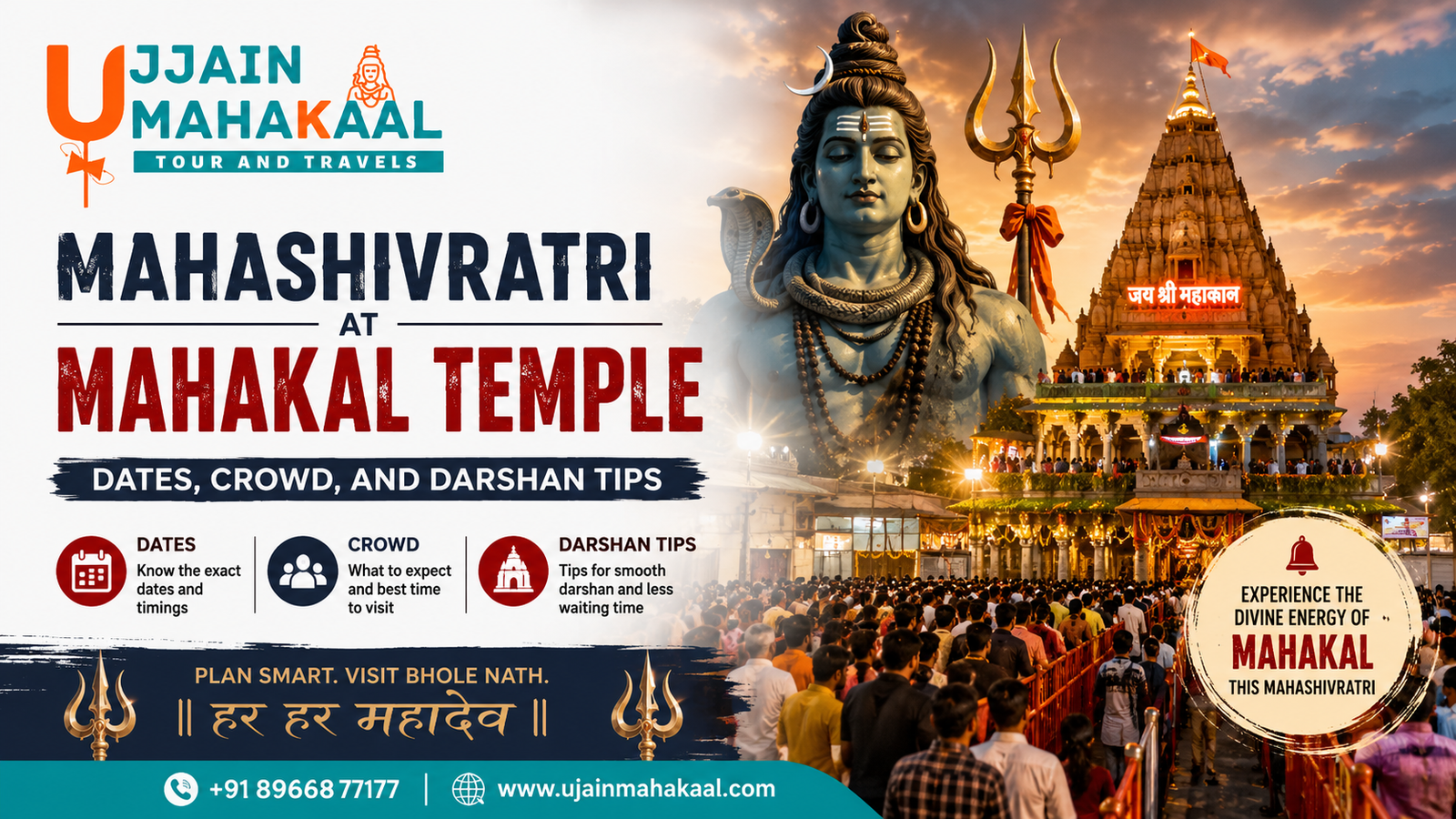
If there is one night in the year when Ujjain stops being just a city and becomes a living temple, it’s Mahashivratri. Lakhs of devotees converge on the Mahakaleshwar Jyotirlinga for what is easily the most intense, most crowded, and most spiritually charged darshan of the year. If you’re planning to be here for it, this guide covers exactly what to expect and how to prepare.
When Is Mahashivratri Celebrated at Mahakaleshwar
Mahashivratri falls on the Chaturdashi tithi of Krishna Paksha in the Hindu month of Phalguna, so the Gregorian date shifts every year — usually landing somewhere in February or early March. The next major observance falls on Saturday, 6 March 2027.
What makes Mahakaleshwar different from most Shiva temples is that the celebration isn’t a single night — it’s a build-up. The temple observes a 9-day Shiv Navratri Shringar Utsav in the lead-up to Mahashivratri, where Lord Mahakal is adorned in a different divine form each day — from the Chandan (sandalwood) Shringar on day one to the Uma-Mahesh Shringar with Parvati closer to the main night. Each day draws its own crowd of devotees who specifically come to witness that particular Shringar, so if you’re flexible on dates, some of these earlier days can actually offer a calmer darshan than the peak night itself.
On Mahashivratri night, the temple effectively stays active for over 36 hours straight, with darshan, abhishek, and aarti cycles continuing well past midnight and into the next morning — this uninterrupted stretch is often referred to locally as the 44-hour darshan window.
How Big Is the Crowd, Really
This isn’t a festival you casually walk into. On Mahashivratri day, upwards of a million devotees pass through Mahakaleshwar over the course of the celebration, and local administration deploys large-scale crowd management, barricading, and additional police force to keep the flow moving. Queues that would normally take 30–45 minutes on a regular day can stretch to several hours, particularly through the afternoon and evening.
A few things drive the crowd surge specifically for Mahashivratri:
- Night-long worship is the whole point. Unlike most festivals in Ujjain, the most intense spiritual activity here happens after sunset, culminating at Nishita Kaal — the middle of the night — when the temple is at its fullest.
- Out-of-state devotees. Because Mahakaleshwar is one of the twelve Jyotirlingas, this is a bucket-list darshan for Shaivite pilgrims from Maharashtra, Gujarat, Rajasthan, and beyond, not just locals.
- The Bhasma Aarti gets a special version. The regular early-morning Bhasma Aarti is expanded and run with far larger devotee participation, and general entry tickets for that morning sell out well in advance.
Darshan Tips for Mahashivratri
1. Book your darshan pass in advance, not on arrival. General and VIP darshan passes for Mahashivratri go live on the official temple booking system weeks ahead and sell out fast. Walking in without a pass on the day itself usually means the longest possible queue.
2. Pick your day inside the 9-day window, not just the main night. If your priority is seeing Mahakal without standing for six hours, consider visiting on one of the earlier Shringar days (days 1–5) rather than the main Mahashivratri night. You still get a Shringar darshan, just with a fraction of the crowd.
3. Plan for an overnight stay, not a day trip. Since the most significant worship happens late at night, trying to do Mahashivratri as a same-day in-and-out trip from Indore or Bhopal is exhausting and often not worth it. Book accommodation near the temple at least a month in advance — hotels around Mahakaleshwar fill up quickly for this window.
4. Dress for a long wait, not a quick visit. February nights in Ujjain get cold, and you may be standing in an open queue for hours. Carry a light jacket, comfortable closed shoes, and avoid heavy bags — security checks are stricter during the festival and large bags will slow you down or get you turned away at the gate.
5. Keep valuables minimal. In dense crowds, pickpocketing risk goes up. Carry only what you need — ID, phone, cash for offerings — and avoid loose jewelry.
6. Senior citizens and families should use the separate queue lines. The temple administration typically sets up dedicated lanes for elderly devotees, women, and people with disabilities during high-crowd festivals. Ask temple volunteers or police on duty — they’ll direct you rather than making you stand in the general line.
7. Eat before you queue. Once you’re in the darshan line, there’s no stepping out. Have a proper meal and stay hydrated before joining, especially if you’re doing the overnight vigil.
8. Don’t skip the pre-planning just because it’s “just one night.” Mahashivratri at Mahakaleshwar is closer to a multi-day pilgrimage event than a single evening — treat your travel, stay, and darshan booking with the same lead time you’d give a major festival trip, not a weekend visit.
Planning Your Mahashivratri Trip to Ujjain
Given the scale of the crowd and the number of moving pieces — darshan pass booking, accommodation, local transport between your hotel and the temple, and timing your visit around the Shringar schedule — most first-time visitors find it far easier to travel with a local operator who already knows the festival logistics rather than figuring it out on arrival.
If you’re planning to be in Ujjain for Mahashivratri, reach out to us for help with darshan pass booking, stay arrangements near the temple, and local transport for the festival dates — it takes the guesswork out of what is otherwise one of the most demanding pilgrimage windows of the year.
Mahashivratri at Mahakal Temple: Dates, Crowd, and Darshan Tips
Mahashivratri at Mahakal Temple: Dates, Crowd, and Darshan Tips If there is one night in the year when Ujjain stops being just a city and becomes a living temple, it’s