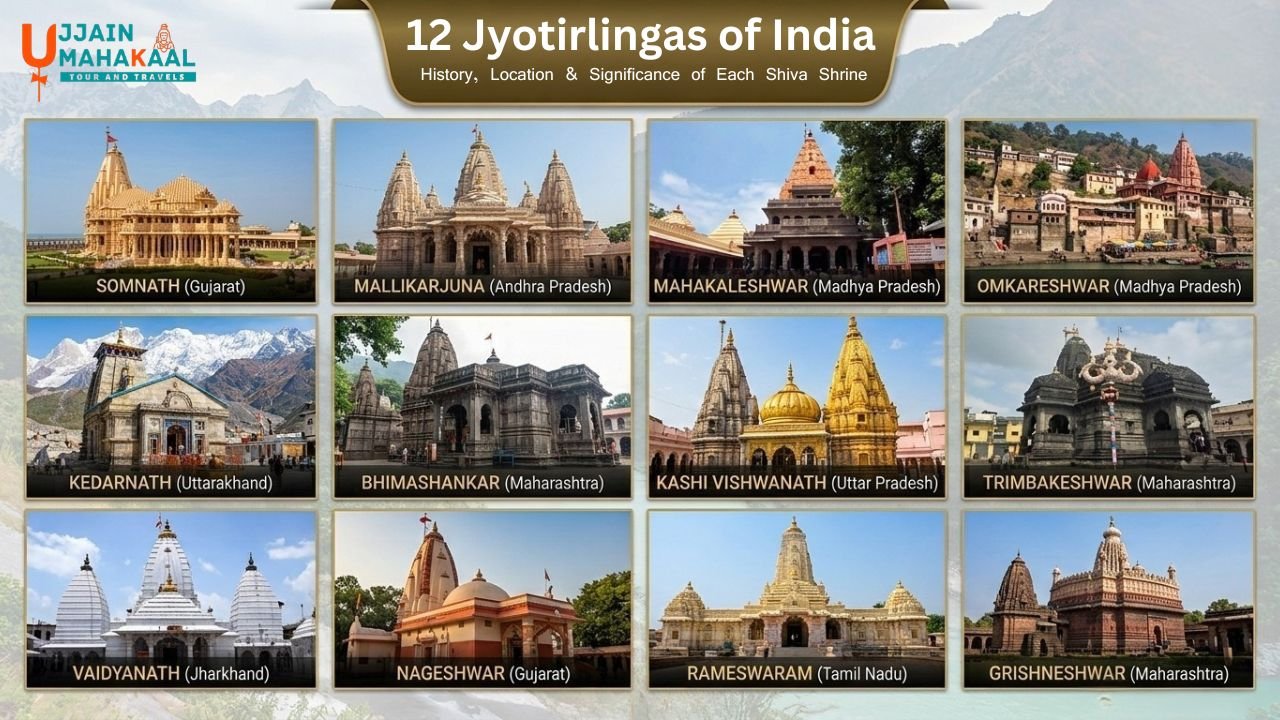
1. Somnath Jyotirlinga — The First Among Equals
Somnath sits on the western coastline of Gujarat, at Prabhas Patan near Veraval, right where the Arabian Sea touches the shore. Most traditional listings place Somnath first in the sequence of the 12 Jyotirlingas, and its story goes back to the Moon God, Chandra Dev. According to legend, Chandra was cursed and lost his glow; he worshipped Shiva at this spot to regain his light, and this is why the temple is closely tied to the waxing and waning of the moon even today.
Main point: What makes Somnath stand out historically is its sheer resilience — the temple has been destroyed and rebuilt multiple times over centuries, with the present structure completed in 1951 under the initiative of Sardar Vallabhbhai Patel. Today it stands as a symbol of faith surviving through history.
2. Mallikarjuna Jyotirlinga — The Kashi of the South
Perched on the Srisailam hills in Andhra Pradesh, overlooking the Krishna River, Mallikarjuna holds a rare distinction — it is one of the few places where a Jyotirlinga and a Shakti Peeth exist together, since Goddess Parvati is worshipped here as Bhramaramba. This is why the temple is often referred to as the “Kashi of the South.”
Main point: The setting itself adds to its charm — dense forests, hill terrain, and a temple complex that blends Shaivite and Shakti traditions in one sacred space, making it a favourite among pilgrims who want to experience both energies in a single visit.
3. Mahakaleshwar Jyotirlinga — The Only South-Facing Shiva Shrine
Right here in Ujjain, Madhya Pradesh, stands Mahakaleshwar — the Jyotirlinga we personally help pilgrims visit every day. What sets it apart from all other 11 is that it is Dakshinamukhi, meaning south-facing, a direction linked with Yama, the god of death and time. This is believed to give Mahakaleshwar special power over untimely death and negative planetary doshas.
Main point: The temple’s fame largely comes from its Bhasma Aarti, performed before sunrise using sacred ash — a ritual found nowhere else among the 12 Jyotirlingas. The local legend tells of a demon named Dushan who terrorised Ujjain’s people until Shiva rose from the earth itself to destroy him and protect the city, which is why Mahakaleshwar is also seen as the eternal guardian of time (Kaal).
If you’re planning to see this Jyotirlinga, our Mahakaleshwar Tour Packages include Bhasma Aarti booking assistance and complete darshan planning.
4. Omkareshwar Jyotirlinga — Shiva on the Om-Shaped Island
A short drive from Ujjain, Omkareshwar sits on Mandhata Island in the middle of the Narmada River — and remarkably, the island’s natural shape resembles the sacred “ॐ” (Om) symbol, which is exactly where the temple gets its name.
Main point: Legend says this is where King Mandhata once performed intense penance to please Lord Shiva. Interestingly, Omkareshwar is often visited alongside Mahakaleshwar in a single trip, since the two are just a couple of hours apart — one of the most convenient Jyotirlinga combinations in India.
Our Ujjain-Omkareshwar Tour is designed exactly for this pairing.
5. Kedarnath Jyotirlinga — Shiva in the Himalayas
Kedarnath is unlike any other Jyotirlinga on this list — situated deep in the Garhwal Himalayas of Uttarakhand, at an altitude that keeps it snow-covered and completely inaccessible for nearly six months of the year. Pilgrims can only visit between late April and early November.
Main point: According to the Mahabharata, the Pandavas came here seeking forgiveness from Shiva after the Kurukshetra war, but Shiva evaded them by taking the form of a bull and diving into the ground, leaving behind a hump-shaped rock that is worshipped here today.
6. Bhimashankar Jyotirlinga — Hidden in the Sahyadri Forests
Tucked away in the Sahyadri hill ranges near Pune, Maharashtra, Bhimashankar is as much a nature retreat as it is a pilgrimage site — the temple lies inside a designated wildlife sanctuary, surrounded by thick forest cover.
Main point: The legend connects to Bhima, a fierce demon defeated here by Shiva, and the temple is also believed to be the origin point of the Bhima River, which flows from this very hill down into the plains of Maharashtra.
7. Kashi Vishwanath Jyotirlinga — The Gateway to Moksha
In the ancient, ever-alive city of Varanasi (Kashi), on the banks of the Ganga, stands one of the most visited Jyotirlingas in India — Kashi Vishwanath. Hindu belief holds that dying or being cremated in Kashi grants direct moksha (liberation from the cycle of rebirth), making this one of the most spiritually significant cities in the entire country.
Main point: The ghats, the evening Ganga Aarti at Dashashwamedh Ghat, and the narrow lanes surrounding the temple together create an experience that goes far beyond just a temple visit.
8. Trimbakeshwar Jyotirlinga — Source of the Godavari River
Near Nashik in Maharashtra, Trimbakeshwar holds a rare architectural feature — its Shivling has three small faces representing Brahma, Vishnu, and Shiva together, which is why it’s called “Trimbak” (three-eyed).
Main point: The temple also marks the origin of the Godavari River, one of India’s most sacred rivers, often called the “Ganga of the South.” Trimbakeshwar is also closely associated with the Kumbh Mela, as Nashik is one of the four cities where this massive gathering is held.
9. Vaidyanath Jyotirlinga — The Healing Shrine of Deoghar
Also known as Baidyanath Dham, this Jyotirlinga in Deoghar, Jharkhand, carries a unique reputation — devotees come here specifically seeking relief from illness and suffering, since “Vaidya” means physician, and Shiva is worshipped here in the role of the ultimate healer.
Main point: According to legend, Ravana once tried to carry the Shivling to Lanka after pleasing Shiva through penance, but was tricked into placing it on the ground at Deoghar, where it became permanently fixed.
10. Nageshwar Jyotirlinga — Protector From Poison and Negative Energy
Located near Dwarka in Gujarat, Nageshwar’s name itself comes from “Naga” (serpent), and the temple is believed to protect devotees from poison, venom, and negative energies of all kinds.
Main point: The legend tells of a demon named Daruka who imprisoned a Shiva devotee named Supriya; when Supriya continued chanting Shiva’s name even in captivity, Shiva appeared and destroyed the demon, establishing himself here as Nageshwar — the protector of the faithful.
11. Rameshwaram Jyotirlinga — Established by Lord Rama Himself
At the very southern tip of India, on Rameswaram Island in Tamil Nadu, stands a Jyotirlinga with a direct connection to the Ramayana. Legend says Lord Rama himself installed and worshipped a Shivling here to seek forgiveness before crossing over to Lanka to rescue Sita.
Main point: Rameshwaram is also part of the Char Dham pilgrimage circuit, and its temple is famous for the longest corridor of any Hindu temple in India, lined with intricately carved pillars.
12. Grishneshwar Jyotirlinga — The Final Shrine, Near Ellora
Rounding off the list is Grishneshwar, located in Verul village near the world-famous Ellora Caves in Maharashtra. It is traditionally regarded as the last of the 12 Jyotirlingas of India, and its story centers on a devotee named Kusuma, whose unwavering faith led Shiva to revive her son and manifest at this spot.
Main point: Being right next to the Ellora Caves — a UNESCO World Heritage Site — means visitors often combine their Grishneshwar darshan with a heritage tour of the rock-cut caves on the same trip.